четверг, 10 декабря 2020 г.

1 курс. Основные типы вопросов


ОСНОВНЫЕ ТИПЫ ВОПРОСОВ


1. Общий вопрос (General Question)

Общий вопрос относится ко всему предложению в целом, и ответом на него будут слова yes или по: 

Do you like ice-cream? — Yes, I do. 

Can you speak English? — Yes, I can. 

Are you a schoolboy? — No, I am not. 

Have you bought a text book? — Yes, I have.

Порядок слов в общем вопросе

1) вспомогательный (модальный, глагол-связка) глагол,

2) подлежащее (существительное или местоимение),

3) смысловой глагол (или дополнение).

2. Специальный вопрос

Специальный вопрос относится к какому-нибудь члену предложения или их группе и требует конкрет­ного ответа:

What is your name? — My name is Peter.

Where do you live? — / live in Rostov.

Специальный вопрос всегда начинается со специ­ального вопросительного слова:

who (кто)                 where (где)

whom (кого)            why (почему)

what (что)                how long (как долго)

which (который)     how many (сколько)

whose (чей)             how much (сколько)

when (когда)            how (как)

Порядок слов в специальном вопросе

1)вопросительное слово (what, where, who, when, how и т. д.),

2)вспомогательный (модальный, глагол-связка) глагол.

3)подлежащее,

4)смысловой глагол,

5)дополнения,

6)обстоятельства (места, времени, образа действия и т. д.)

В специальных вопросах, обращенных к подлежа­щему в формах Present и Past Indefinite, не употреб­ляется вспомогательный глагол to do (did) и сохра­няется прямой порядок слов:

Who wants to go to the cinema?

Whose pen is it?

Who lives here?

3. Альтернативный вопрос

Альтернативный вопрос предполагает выбор из двух возможностей:

Do you like coffee or tea? — Вы любите кофе или чай?

Альтернативный вопрос начинается как общий воп­рос, затем следует разделительный союз or и вторая часть вопроса.

4. Разделительный вопрос (Tail Question)

Разделительный вопрос состоит из двух частей. Первая часть —это повествовательное предложение (утвердительное или отрицательное), вторая, отделен­ная запятой от первой — краткий вопрос (tail — «хвост»), который на русский переводится не правда ли? не так ли?

You are a pupil, aren't you? — Вы ученик, не прав­да ли?

You aren't a pupil, are you? — Вы не ученик, не правда ли?

В кратком вопросе повторяется вспомогательный, модальный или связочный глагол предложения, со­держащего заявление. Если сказуемое предложения выражено глаголами to be или to have, то повторяют­ся эти глаголы.

Не is reading, isn't he? Он читает, не так ли? (По­вторяется вспомогательный глагол.)

Не can read, can't he? Он умеет читать, не так ли? (Повторяется модальный глагол сап.)

Не is a good pupil, isn't he? Он хороший ученик, не так ли? (Повторяется связочный глагол to be.)

Не has a book, hasn't he? У него есть книга, не так ли? (Повторяется глагол to have, употребляемый как смысловой глагол.)

Если в повествовательной части разделительного вопроса содержится утверждение, то во второй — от­рицание.

Если в повествовательной части — отрицание, то во второй части, как правило, — утверждение:

Не is there, isn't he? Он там, не так ли?

Не isn't there, is he? Он не там, не так ли?


Задание 8.1. Прочтите и переведите на русский язык.

Поставьте к каждому предложению разделитель­ный вопрос.

1.      She is a student.

—     Is she a student?

—     Yes, she is. / No, she isn't.

2.      He speaks English well.

—     Does he speak English well?

—     Yes, he does. / No, he doesn't.

3.      They have many books.

—     Have they many books?

—     Yes, they have. / No, they haven't.

4.      The weather was fine yesterday.

—     Was the weather fine yesterday?

—     Yes, it was./No, it wasn't.

5.      We saw a new film yesterday.

—     Did we see a new film yesterday?

—     Yes, we did. / No, we didn't.

6.      You can read well.

—        Can you read well?

—       Yes, you can. / No, you can't.

7.     There will be five lessons tomorrow.

—    Will there be five lessons tomorrow?

—    Yes, there will. / No, there will not (won't).

Задание 8.2. Переведите предложения с альтерна­тивными вопросами на русский язык.

1.    Our family lives in a three-room flat.

—     Does your family live in a three-room flat or in a house?

—    It lives in a three-room flat.

2.    They went to the same school.

—   Did they go to the same school or to different

schools?

—   They went to the same school.

3.   He will read this book tomorrow.

— Will he read this book tomorrow or next week?

—  He will read it tomorrow.

4.   They are playing football now.

— Are they playing football or tennis now?

—  They are playing tennis.

5.    Our teacher has told us to write.

—   Has our teacher told us to write or to read? He has told us to write.


Задание 8.З. Поставьте к следующим предложени­ям вопросы:

1. общие

2. специальные

3. разделительные

1. There is a book on the table. 2. He must work hard today. 3. We are leaving for Moscow next week. 4. We were reading the whole evening. 5. They don't go to work on Sunday. 6. It is not cold today. 7. Ann has already be­gun to read a new book. 8. We learn English at school. 9. They will show you how to get there.

 Задание 8.4. Переведите предложения на англий­ский язык.

1. Вам нравится больше английский язык или французский?

2.  Он живет в Ростове или в Москве?

3.  Она его младшая или старшая сестра?

4.  Студенты уже сдали экзамены или нет?

5.  Петровы поедут летом на юг или на север?

6.  Ваш друг учится в колледже или в университете?

7.  Он знает ее лучше или вы?


 Задание 8.5. Составьте письменно общие вопросы к следующим предложениям.

1. Our teacher knows several foreign languages. 2. He has graduated from our University last year. 3. We shall go to Samara next week. 4. They are working in our gar­den .5.1 have j ust read this book. 6.1 took this book from my friend. 7. He likes reading books. 8. She has many rel atives abroad. 9. They were in many countries. 10. Rus­sia is the largest country in the world.


воскресенье, 6 декабря 2020 г.

1 курс Sports

 1 курс

SPORTS    

            Sport is very popular among people in all the coun­tries of the world. Sport makes people healthy, keeps them fit, more organised and better disciplined. It unites people of different classes and nationalities. Many peo­ple do sports on their personal initiative. They go in for skiing, skating, table tennis, swimming, volleyball, foot­ball, basketball, body-building etc.

All necessary facilities are provided for them: stadi­ums, sport swimming-pools, skating-rinks, football fields. But, of course, one have to pay for these services.

Sport is paid much attention to in our schools and colleges. Physical training is a compulsory subject. Dif­ferent sports and games are popular with my class­mates. All my friends go in for different kinds of sport, such as water sports (that is swimming, sailing, row­ing), gymnastics, horse-racing, wrestling, fencing, weightlifting, boxing, football, basketball, volleyball, etc.

Physical training lessons at our college are held out-of-doors In summer. When it is cold outside the lessons are held indoors in our college gymnasium.

Professional sport is also paid much attention to in our country. In the city where I live, there are different sport societies, clubs and sport schools. Practically all kinds of sports are popular in our country, but gymnas­tics and tennis enjoy the greatest popularity.

The most popular kinds of sports in the United States are baseball, basketball and American football. In Eng­land popular kinds of sports are golf and rugby. English­men like football too. It is their national kind of sports.

1.Words

all over the world — во всем мире

to be fond of — зд. любить

healthy — здоровый

to be fit — быть в форме

personal initiative — личная инициатива

skiing — лыжный спорт

skating — коньки

body-building — культуризм

facilities — помещения, оборудование

swimming-pool — плавательный бассейн

skating-rink — каток

attention — внимание

compulsory — обязательный

sailing — парусный спорт

rowing — гребля

wrestling — борьба

fencing — фехтование

weightlifting — штанга

out-of-doors — на воздухе

indoors — в помещении

sport societies — спортивные общества

2.Questions

1.  Why do people all over the world are fond of sports and games?

2.  What are summer sports and what are winter sports? 

3.  What kind of sports are popular with your friends?

4.  Do you have to pay for sports facilities, such as sta­diums, swimming pools and tennis courts?

5.  What can you say about physical training lessons at your college?

6.  What kinds of sport are most popular in our coun­try?

7.  What are the sports organisations in our country?

8.  What are the most popular kinds of sport in Amer­ica and England? What other American or English kinds sports do you know?

10.    Are American football and baseball popular inRussia? Why and why not?


воскресенье, 29 ноября 2020 г.

1 курс. Seasons and Weather. Неопределенные местоимения some, any,no и их производные.


  1 курс

SEASONS AND WEATHER

There are four seasons in a year: winter, spring, sum­mer and autumn. Each of them lasts three months.

Summer is my favourite season. June, July and Au­gust are summer months. When summer comes, the weather gets warmer and sometimes it can be very hot. In summer people spend much time in the open» They find time to go to the forest or to swim in the river. School­children like their summer holidays.

Autumn comes in September with the beginning of the school year. It is the time when fruit and vegetables be­come ripe. It is a very beautiful time of the year when the weather is still warm and the leaves change their col­our from green to yellow and red. But then it gets colder. The leaves fall from the trees and cover the ground. Birds fly away to warm countries. Then winter comes.

Winter is usually a cold season. It often,snows, rivers and lakes are frozen. The sun sets early and rises late —

especially in December and January. The days are short, the sky is often grey. Every New Year begins in winter on the first of January. It's a holiday and people deco­rate their flats with New Year trees.

Spring begins in March. The weather gets better and the sun shines more brightly. The days become longer. The birds return from the South and make their nests. It sometimes rains but the sky is usually bright-blue and it is warm.

1.Words

season — время года

each — каждый

to last — длиться

in the open — на воздухе

fruit — фрукты

vegetables — овощи

ripe — спелый

still — все еще

warm — теплый

cold — холодный                

to fall — падать

to cover — покрывать

to set — садиться

to rise — вставать

to decorate — украшать

New Year tree — елка

frozen — замерзший

to return — возвращаться

nest — гнездо

2.Ответьте на вопросы:

1. How many seasons are there in a year?

2. Do people try to spend more time in the open air in summer?

3. Why do we like spring so much?

4. Is summer the best season for tourism?

5. Where did you go last summer?

6. What is the weather like in winter?

7. Do you like winter? Why?

8. Do you go in for skating or skiing in winter?

9. What do you usually do when the weather is bad in autumn and winter?

10.What is good and what is bad in each season?

11.Why do most people prefer summer to any other season of the year?

12.What is your favourite season?

13.What are the hottest and the coldest seasons in our country?


НЕОПРЕДЕЛЕННЫЕ МЕСТОИМЕНИЯ  

SOME, ANY 

ОТРИЦАТЕЛЬНОЕ МЕСТОИМЕНИЕ 

N0 

И ИХ ПРОИЗВОДНЫЕ


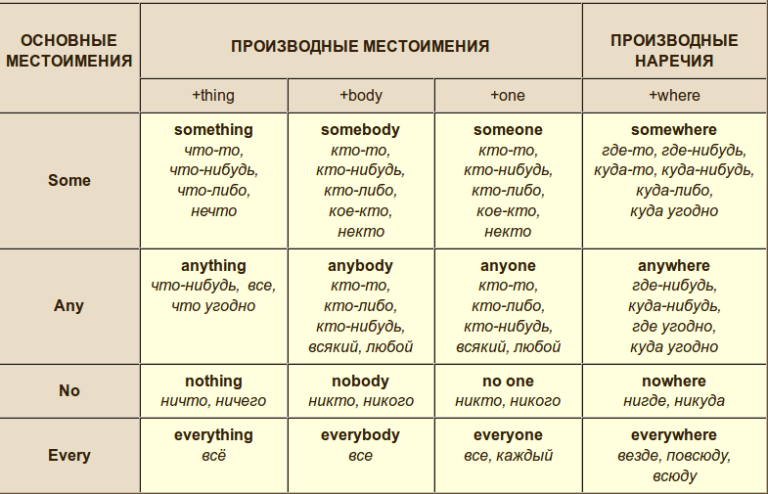
Indefinite Pronouns или неопределенные местоимения – группа, которая показывает, что местоимение не относится к определенному лицу, месту или предмету. Чаще всего эту группу используют, когда просто не знают или не имеют желания называть кого-то / что-то конкретное.

К этой группе можно отнести 4 основных местоимения:

  • some (какие-то, некоторые);
  • any (какие-то, некоторые, всякий);
  • no (никакой);
  • every (каждый)

С помощью них образуется ряд производных, оканчивающихся на –body, –one, –thing, –where.

Так, если речь в неопределенном местоимении идет о людях, они могут содержать в себе –body и –one:

Основные местоименияПроизводные
onebody
somesomeone — кто-тоsomebody — кто-то
anyanyone — кто-тоanybody — кто-то
nono one — никтоnobody — никто
everyeveryone — всеeverybody — все

Если речь идет о какой-либо вещи, к местоимениям добавляется –thing:

Основные местоименияПроизводные
thing
somesomething — что-то
anyanything- что угодно
nonothing — ничего
everyeverything — всё

Если подразумевается местоположение, к основным местоимениям присоединяется –where:

Основные местоименияПроизводные
where
somesomewhere — где-то
anyanywhere — где-нибудь
nonowhere — нигде
everyeverywhere — везде

В этом случае производные становятся наречиями.

Помимо вышеупомянутых неопределённых местоимений используются и следующие:

allвесь, вся, все, всё
oneлюбой
noneникто, ничто
otherдругой
anotherдругой
bothоба
eitherлюбой (из двух)
neitherни тот, ни этот


Home task

Задание 9.1. Образуйте 16 производных местоиме­ний и переведите их.

Образец: some + body = somebody — кто-то, кто-нибудь

some    body

any       one

no         thing

every    where


Задание 9.2. Вставьте somebody, anybody, nobody или everybody.

1. The question is so difficult that... can answer it. 2.... left his bag in our classroom yesterday. 3. Has... in this group got a dictionary? 4. It is too late. I think there is... in the office now. 5. ... knows that plants like water. 6. Is there... here who knows English? 7. You must find... who can help you. 8.... knew anything about our home task. 9. The question is very easy. ...can answer this question. 10. There is... in the next room. I don't know him. 11. Please, tell us the story. ... knows it. 12. Is there... you want to tell me? 13. Has... here got a red pencil?

 Задание 9.З. Переведите на английский язык, упот­ребляя неопределенные (или отрицательные) место­имения и их производные.

1. Есть кто-нибудь здесь? 2. В саду никого нет. 3. В нашей комнате есть кто-нибудь? 4. В классе есть кто-то. 5. В саду есть кто-нибудь? — Там никого нет. 6. На столе есть что-нибудь? — Нет, там ничего нет. 7. В сум­ке что-то есть. 8. В этой книге есть что-нибудь интерес­ное? 9. На стене есть какие-нибудь картины? — Да, там есть несколько. 10. В комнате есть кто-нибудь? — Нет, там никого нет. 11. В нашей библиотеке есть какие-то книги на английском языке. 12. В вашей библиотеке есть какие-нибудь книги на английском языке? 13. Мой друг не хочет мне ничего сказать. 14. Возьми­те что-нибудь почитать для меня в библиотеке. 15. Если вы голодны (to be hungry), поищите (look for) что-ни­будь в холодильнике (fridge). 16. Расскажите нам всё о вашем путешествии. 17. Никто нигде не помог ему.


\1

3 курс

  Law Breakers   TASK 1. Match each word on the left with the appropriate definition on the right: 1)     b) 2e 3a 4c 5n 6d 7f 8k 9h 10l 11j...